Types of budget templates
Two questions explain most of the differences: how much do you have to enter, and what approach to budgeting does the template follow?
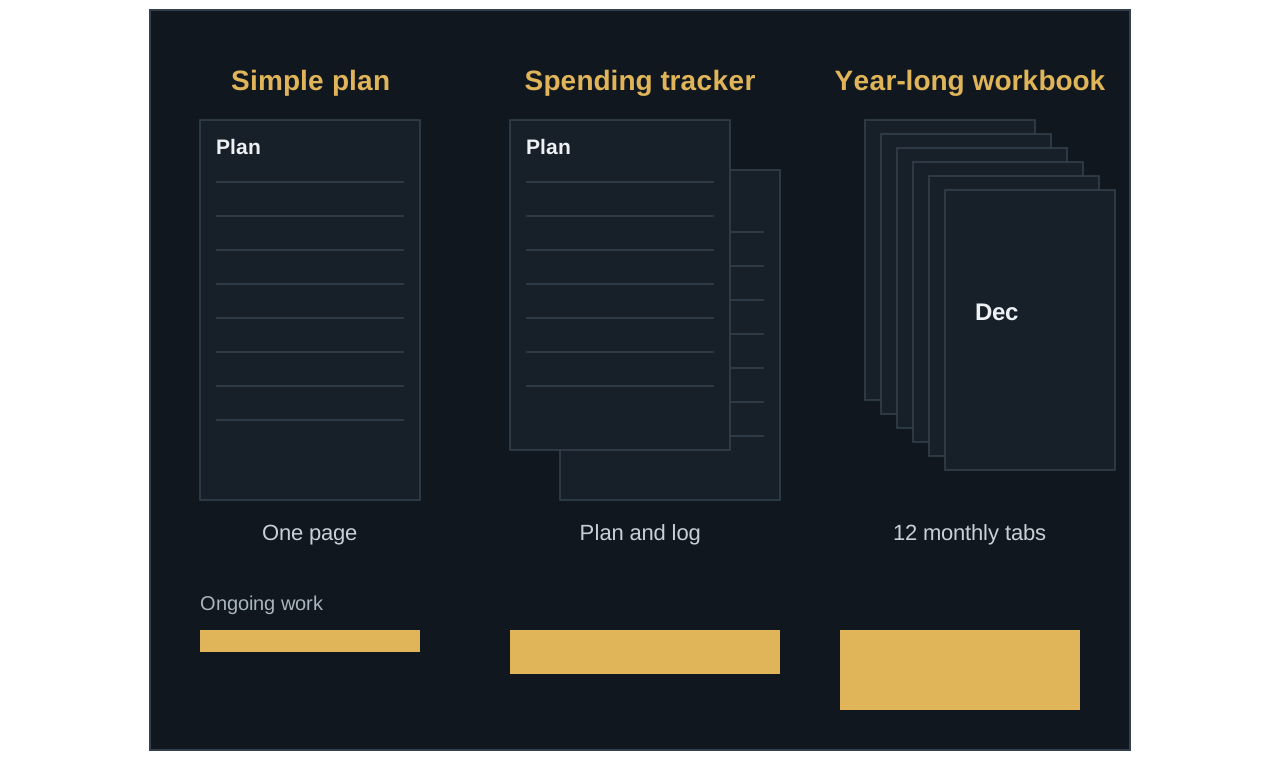
1 of 4
A simple plan
One page of income and planned costs. It tells you whether the plan adds up, without following every purchase.
2 of 4
A spending tracker
A plan and a log of what you actually spent. This shows where the money really goes.
3 of 4
A year-long workbook
Monthly tabs and a yearly view. This lets you compare months, if you keep them all up to date.
4 of 4
More to keep up
More detail generally means more ongoing work. Choose the size you’ll really maintain.
More tabs mean more to keep up.
A bigger workbook is useful only if you’ll maintain it.
How much you enter
| Kind | Your ongoing work | Can answer | Can’t answer well |
|---|---|---|---|
| Simple plan | Light: update it when your plan changes | Does my plan add up? | Where did my money really go? |
| Spending tracker | Regular: record your spending | Am I sticking to my plan? | Longer patterns, unless it covers more months |
| Year-long workbook | Regular, for the whole year | How do my months compare? | Anything from months you didn’t keep up |
More tabs don’t automatically mean a better fit. A large workbook is useful only if you’ll maintain it, and extra trackers add more to keep updated.
Which budgeting method it follows
Each example below uses a made-up take-home income of $3,000 a month.
| Method | The idea | Example | A template helps by |
|---|---|---|---|
| 50/30/20 | Split take-home pay among needs, wants, and savings or debt | $1,500 needs, $900 wants, $600 savings and debt | Calculating the three targets |
| Zero-based | Give every dollar a job until none is left unassigned | Categories planned until they total exactly $3,000 | Showing what’s still unassigned |
| Envelope | Set a limit for each category, and stop when it runs out | $400 for groceries, with $120 left after $280 of spending | Tracking each category’s balance |
| Pay yourself first | Set aside savings first, and spend from the rest | $300 to savings, leaving $2,700 | Showing what remains after savings |
None of these is right for everyone. The percentages in 50/30/20 are a common rule of thumb, and they may not suit your costs or where you live. See how each method works in more detail.
A quick way to choose
- New to budgeting and unsure where your money goes? A spending tracker gives you the most useful information.
- Need a rough answer about affording something? A simple plan may be enough.
- Already tracking and want to see trends? A year-long workbook gives you room to compare.