Budgeting methods in a template
A budgeting method is a set of rules for planning your money. A template can apply those rules to your numbers, but you still have to choose a method that fits your life.
1 of 4
50/30/20
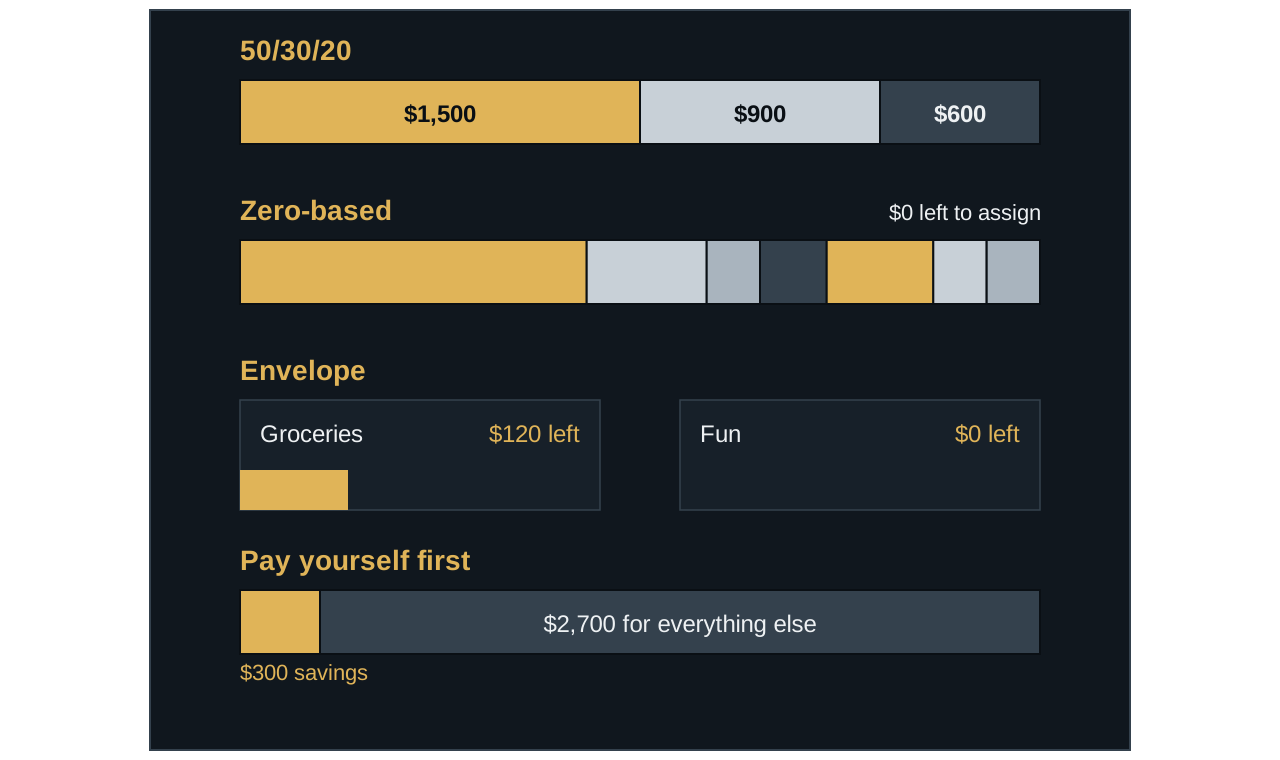
A made-up $3,000 becomes $1,500 for needs, $900 for wants, and $600 for savings and debt.
2 of 4
Zero-based
Every dollar gets a job, including savings, until nothing is left to assign.
3 of 4
Envelope
Each category has a limit. When a balance reaches zero, you stop or move money from elsewhere.
4 of 4
Pay yourself first
Savings comes out first. Here, $300 goes to savings, and the other $2,700 covers everything else.
A method is just a set of rules.
A template can apply the rules. You still choose the ones that fit.
The examples below use a made-up take-home income of $3,000 a month. Take-home pay is what you receive after taxes and other deductions.
50/30/20
This method divides take-home pay into three broad groups: 50% for needs, 30% for wants, and 20% for savings and debt payoff. Try it with a different amount.
- Needs (50%)
- $1,500
- Wants (30%)
- $900
- Savings and debt (20%)
- $600
Good for: a simple framework without many categories. Watch out for: where housing and other essentials take up much more than half of your pay, these percentages may not be realistic. Look for: a template that calculates the targets, and lets you change the percentages.
Zero-based
You give every dollar a job until your income minus your plan equals zero. That doesn’t mean spending everything, because savings is one of the jobs.
| Job | Planned |
|---|---|
| Rent | $1,300 |
| Groceries | $450 |
| Bills and utilities | $200 |
| Transport | $250 |
| Savings | $400 |
| Debt payment | $200 |
| Fun | $200 |
| Total, leaving $0 unassigned | $3,000 |
Good for: people who want to decide where everything goes. Watch out for: it takes more planning and regular adjusting. Look for: a clear “left to assign” number.
Envelope
The traditional version puts cash into labeled envelopes. When an envelope is empty, spending in that category stops. In a spreadsheet, each category works as a digital envelope with a running balance.
| Envelope | Set aside | Spent | Left |
|---|---|---|---|
| Groceries | $400 | $280 | $120 |
| Fun | $150 | $150 | $0, so stop or move money from elsewhere |
Good for: categories where you often overspend. Watch out for: a spreadsheet can show that an envelope is empty, but it can’t stop your card from working. Look for: a visible balance for each category.
Pay yourself first
You choose a savings amount before anything else. With $300 set aside, the other $2,700 is what you have for everything else, often with less detailed tracking.
Good for: people whose top priority is saving consistently. Watch out for: with less tracking, you may not see where the remaining money goes. Look for: goal tracking and a simple “what’s left” figure.
You don’t have to choose forever
Many people borrow from more than one method, or change methods as life changes. If you aren’t sure where to start, a simple spending tracker can show where your money goes now. That can make it easier to tell which method would suit you.